


Ethical and sustainable commitment:
CSR at ARITEX
Focused on innovation in strategic sectors such as aeronautics and automotive, we align ourselves with European industrial trends. We address global challenges with a solid commitment to Sustainability, Social Responsibility, and strict compliance with legal regulations applicable at the national and international level.
Our ethical leadership is manifested through a robust Code of Conduct, guiding our team towards fundamental principles of Sustainability, Corporate Social Responsibility and Governance.
We encourage participation and open communication to ensure widespread adherence to these standards, marking our continued dedication to responsible leadership in all our actions.
In the years of our company’s life, after all the changes we have experienced, our constant has been the commitment to leadership in all our actions, always guided by ethics and integrity. Leadership in everything we do means not only pursuing business goals, but achieving them ethically, making decisions that meet applicable standards and rejecting simplistic solutions to problem situations.
We have established a strong Code of Business Conduct and Ethics, designed to guide each member of our team in adopting fundamental principles in their daily work. This code provides clear guidelines so that each employee understands and applies appropriate conduct, disseminating it among collaborators and interested parties. We encourage participation and open communication, defending and publicly sharing the achievements and scope of these principles.
Aritex takes responsibility not only for its direct impact on society, but also for indirect impacts through suppliers and customers, including the well-being of workers. Committed to preventing and reducing any significant negative impacts, we implement an ESG management system that addresses environmental, social and governance factors. This approach promotes sustainability and corporate social responsibility, generating long-term value for shareholders and reaffirming our commitment to society.

Sustainability and Corporate Social Responsibility (ESG)
To achieve the above, 9 principles are proposed at the group level, which must lead the way in terms of strategy, daily decision-making, and organizational structures within the ESG framework.
Principle of legality. Compliance with regulations or legislation is mandatory and it is the responsibility of the company to know, disclose and verify compliance in each work area acting within the parameters established by law.
Principle of transparency. It is the obligation that the company must share all the necessary information to interested parties or stakeholders about the effects that may occur with the activities carried out by the company, especially all those that may have a social and environmental impact. Likewise, the defined corporate social responsibility policy provides important information on the strategies, resources, and results of the actions of social responsibility, including clear, truthful information, in simple language and that will be distributed through all possible media.
Principle of ethics. The base document of the company’s actions is defined in the Code of Ethics, where ethical principles acquire the greatest relevance, since corporate social responsibility cannot exist without corporate actions being ethical, that would be a contradiction. To do this, it is then necessary to consider two values as pillars of action: honesty and integrity. This will allow the company to also generate credibility and reliability throughout general society, thus achieving positive results at a social and environmental level. Which also shows that the economic objective is not the only one.
Principle of globality and transversality. Considering market dynamics and globalization, it is essential for any company to have knowledge of international regulations not only in accounting, financial and/or logistical terms, but also in relation to what corporate social responsibility implies at an international level. In this order of ideas, the company must complement its actions with what is indicated by national and international regulations, using the necessary means to respect and comply with them.
Principle of respect for Human Rights. Although it is known that human rights must be a pillar of action in any area of society, in the particular case of corporate social responsibility and its plans, this must be mandatory, which is why the company promotes and respects what is dictated in the Universal Declaration of Human Rights, which constitutes a key to promoting a culture of social responsibility. Given the above, it is important to highlight that the main articles of said declaration establish equality and freedom; which have a close relationship with business actions in the social field.
Accountability
. This and the principle of transparency are particularly related, given that having spaces for accountability by openly reporting the impact of their activities in the social, economic and environmental dimensions. This accountability becomes a space to respond and take responsibility for the negative effects or impacts of our business activity and from there take preventive measures.
Respect for the environment. In addition to having the ISO 14001 environmental management certification, our company undertakes environmental campaigns, such as calculating the Carbon Footprint, in order to minimize any impact of our activity and even offer clients and collaborators alternatives to participate in them. and reduce its own environmental impact.
Respect for Stakeholders. This principle focuses especially on the direct impact generated on the actors who have a permanent relationship with the company and that this relationship, and the opinions of these actors should be considered in decision-making. Therefore, for this principle it is necessary to establish spaces for dialogue around respect for different opinions and perspectives.
Governance as a management basis, are the actions that the company undertakes to advance towards its objectives, avoiding conflicts and crises, with a view to growth and the development of new business opportunities that differentiate it from the competition, maintaining the reputation of the organization, balancing the needs of the stakeholders, incorporating transparency in all activities with efficient monitoring.
Environmental Performance Report Aritex Cading S.A.U.
Download our Annual Environmental Performance Summary to discover Aritex’s commitment to sustainability. This report, certified under ISO 14001 by AENOR Internacional, provides a systematic and objective evaluation of our environmental actions.
We offer verified information on legal compliance, environmental commitments, and our focus on continuous improvement for a more sustainable future.
Explore how we exceed expectations and address current and future challenges!
ESG Commitments at Aritex
In order to comply with the principles established at Aritex in terms of Sustainability, Corporate Social Responsibility and Governance, we annually release an ESG Report, also known as a Sustainability Report. This report, beyond being a mere document, symbolizes our commitment to transparency and openness regarding the environmental, social, and governance impacts stemming from our actions.
Through this tool, we aim not only to disclose the risks inherent in our operations but also to highlight the opportunities we identify on our path towards more sustainable practices. This approach is not just a way to meet our obligations but also reflects our steadfast commitment to authenticity and integrity in all our endeavours.
The ESG Report serves as a clear testament to how we prioritize sustainability and embrace responsible business practices at the core of our operations. We view this communication as an essential pillar to demonstrate our genuine dedication to building a sustainable and ethical future.
In the development of the Annual ESG Report, Aritex already has documented studies, protocols, and policies in place for its development, including:
Carbon Footprint of the Organization
Aritex works continuously to reduce our carbon footprint and promote sustainable practices across all areas of our organization.
To achieve this goal, we use methods to calculate our carbon footprint according to the GHG PROTOCOL standard, subjecting it to verification by the Applus+ entity for its different scopes.
At Aritex, we represent these values, bringing to life a way of working that sets us apart.

At Aritex, we represent these values, bringing to life a way of working that sets us apart.
They already trust Aritex


Discovering the engineering of tomorrow: News & Blog

From university to industry: the future of automotive engineering
In an industry as demanding as the automotive sector, innovation does not depend solely on technology. It also depends on people who are capable of…

Designing and commissioning Aritex body-in-white assembly lines
Discover how Aritex designs and commissions automated body assembly lines, from the RFQ stage through to the start of series production.

Digitalization and automation in SMEs: how Aritex is democratising Industry 4.0 through ATX Robotics (part 2)
Digitalization and automation are no longer exclusive to large companies. In this article, we explore how Aritex, through ATX Robotics, helps SMEs overcome cultural, economic and technological barriers to move towards a more accessible, scalable and competitive Industry 4.0.

Digital twins in manufacturing: from simulation to virtual commissioning
Industry 4.0 has long recognised that the interconnection of systems and data analysis is key to creating smart, competitive factories. Using the ‘digital thread’ concept…

Aircraft tooling design: technical criteria, challenges and trends
Aeronautical tooling design is key to manufacturing aircraft structures with precision and safety. In this article, we explore its technical challenges and the opportunities offered by additive manufacturing, AI and continuous improvement.

AI in manufacturing automation: integration into design, programming and implementation
The emergence of artificial intelligence (AI) in industry is not merely a question of evolution from traditional automation. We at Aritex have already embraced this…
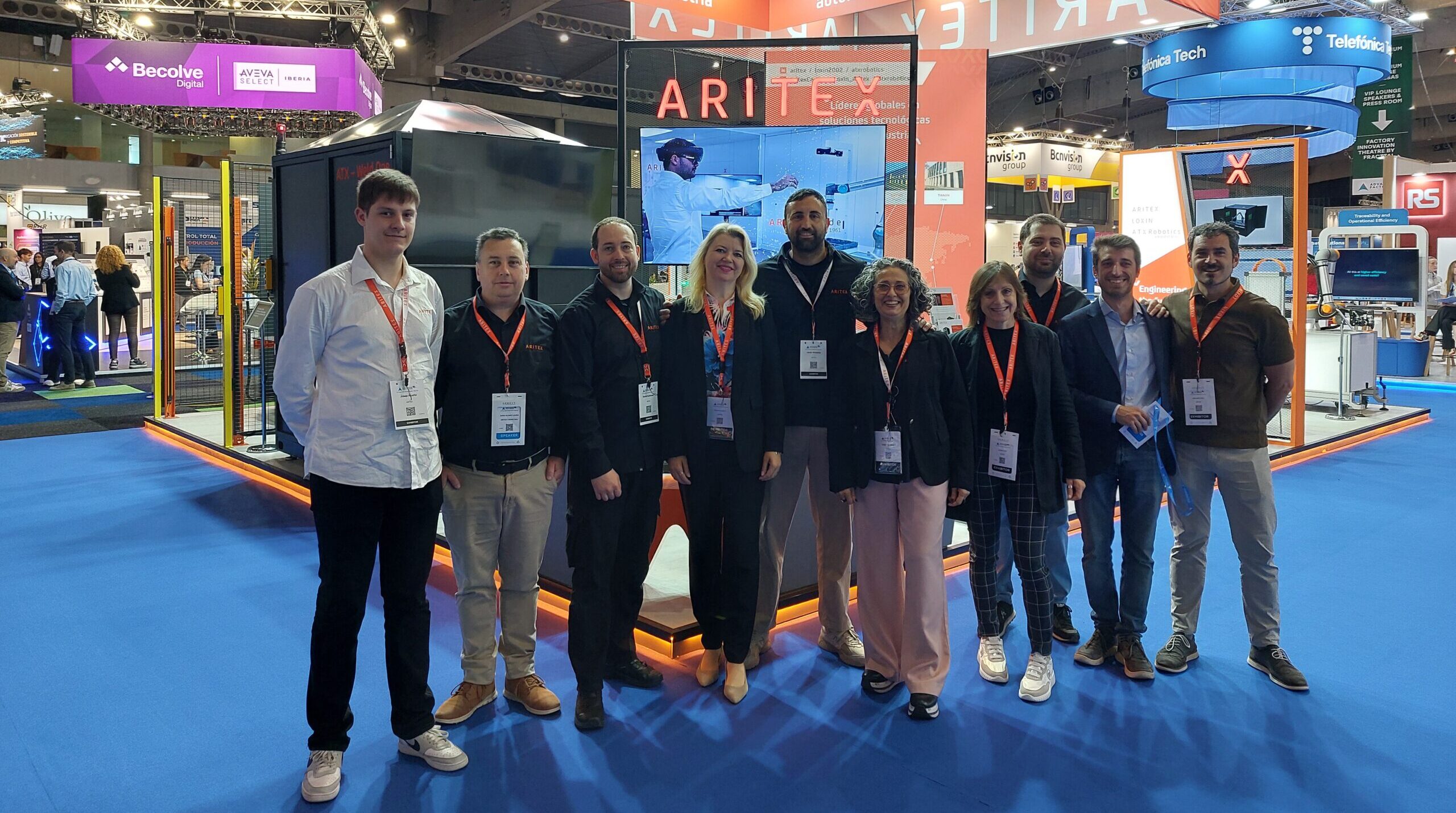
An overview of our participation at Advanced Factories 2026
Advanced Factories 2026 has once again proved to be one of the industry’s major meeting points, a space for sharing real-world experiences and discussing automation,…

Digitalization and automation in SMEs: how Aritex is democratising Industry 4.0 through ATX Robotics (part 1)
After more than six decades leading automation projects for large OEMs, in 2020 Aritex decided to transfer its expertise to the SME sector through a…

ARITEX Group at Advanced Factories 2026 – The industrial automation of the future
The industry is currently going through an exciting period in which automation, robotics and digitalization have become essential pillars for improving productivity, quality and safety…

Aritex Atlantic and Airbus: excellence and precision in aeronautical projects
Aritex Atlantic has consolidated its position in Nantes as an essential strategic partner for Airbus, strengthening and expanding the long-standing collaboration between the Aritex group…