

Sector Aeronautical
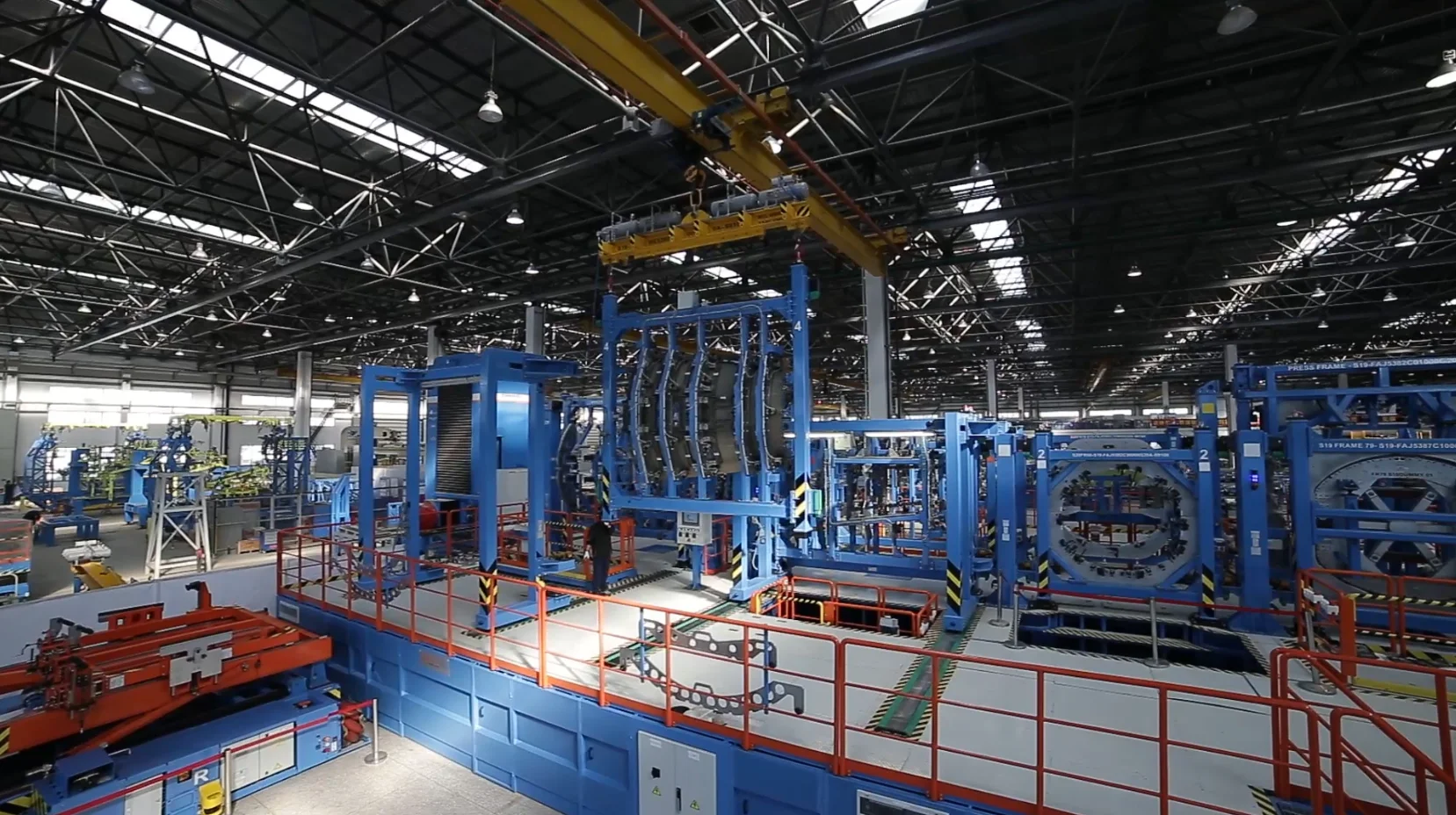
Our collaboration on the “A350XWB Stringer Production Cell” project for Airbus represents a comprehensive, turnkey approach to the manufacture and precise positioning of A350 wing stringers.
This state-of-the-art process begins with the meticulous preparation of the tables for the stringers’ taping, culminating in the placement of the fresh stringers on the cured skin.
The project is divided into two fully automated production lines: one located in Germany for the upper wing skin and the other in Spain for the lower wing skin, both solutions developed in a harmonised manner.
The system designed by Aritex stands out for its exceptional flexibility, offering multiple manufacturing strategies and allowing recovery modes. In addition, it provides the ability to produce several versions of the A350 without the need to completely replace or modify all the tooling according to the spar geometry, only the necessary sectors.
All manufacturing is precisely controlled by a Manufacturing Execution System (MES).
The system boasts an impressive positioning accuracy of 0.2 mm over more than 30 metres.
This project represents an outstanding achievement in aerospace manufacturing, highlighting the precision, efficiency and flexibility that characterises the Airbus industry.


Challenge to be solved
We faced the challenge of enabling the production of individual spars, in a system that places these components one by one on the wing deck, granting great flexibility and precision to the manufacturing process.
To achieve this goal, careful coordination and harmonisation of all technical solutions implemented in two Airbus plants with identical processes is required.
The synchronisation and alignment of these solutions represents a significant challenge, as they must meet Airbus’ stringent quality standards, while ensuring the efficiency and adaptability required in the production of A350XWB spars.
Proposed solution
The solution we created consists of the implementation of a highly advanced robotic air transport system, which has 4 high precision robotic gantries. This system has the capacity to interpolate more than 30 axes in a space of 33 metres, ensuring an exceptional quality of the fresh carbon fibre, avoiding any kind of wrinkles.
The full connectivity of the system, supported by SCADA and MES systems, enables comprehensive control of the manufacturing process, as well as close monitoring of quality. Detailed data is collected at every stage, from lay-up to positioning, providing a complete record of the manufacturing process for each wing.
Full integration of the air and ground transport system with the workstations allows it to function as a single machine, despite its impressive size, covering a lay-out of approximately 120 metres by 40 metres.
At each workstation, cutting-edge technologies are implemented or integrated to provide state-of-the-art solutions, in some cases even requiring the development of customised hardware capabilities to achieve the best technical results.
This comprehensive and innovation-driven approach ensures a highly efficient manufacturing process and exceptional quality in the production of aircraft wings.
This project has been a disruption in the automation of large stringer manufacturing in the aerospace industry.
Do you have in mind carrying out a similar project?
Our engineering experience is not limited to providing and designing solutions: We seek project success.

At Aritex, quality and efficiency start with you. Tell us about your project and together we’ll make it happen. Let’s talk!
They already trust Aritex


Discovering the engineering of tomorrow: News & Blog
Key factors in Aritex’s turnkey projects in the automotive and aeronautical sectors
When analysing a turnkey project once it has been completed, it is easy to focus on the results. However, much of its success will already…

From university to industry: the future of automotive engineering
In an industry as demanding as the automotive sector, innovation does not depend solely on technology. It also depends on people who are capable of…

Digitalization and automation in SMEs: how Aritex is democratising Industry 4.0 through ATX Robotics (part 2)
Digitalization and automation are no longer exclusive to large companies. In this article, we explore how Aritex, through ATX Robotics, helps SMEs overcome cultural, economic and technological barriers to move towards a more accessible, scalable and competitive Industry 4.0.

The value of customized engineering in Loxin’s automated solutions
Discover how Loxin develops customized automation solutions for industrial processes where standard solutions are not enough, combining engineering, automation, and expertise in highly demanding sectors.

Digital twins in manufacturing: from simulation to virtual commissioning
Industry 4.0 has long recognised that the interconnection of systems and data analysis is key to creating smart, competitive factories. Using the ‘digital thread’ concept…

Designing and commissioning Aritex body-in-white assembly lines
Discover how Aritex designs and commissions automated body assembly lines, from the RFQ stage through to the start of series production.

Aircraft tooling design: technical criteria, challenges and trends
Aeronautical tooling design is key to manufacturing aircraft structures with precision and safety. In this article, we explore its technical challenges and the opportunities offered by additive manufacturing, AI and continuous improvement.

AI in manufacturing automation: integration into design, programming and implementation
The emergence of artificial intelligence (AI) in industry is not merely a question of evolution from traditional automation. We at Aritex have already embraced this…
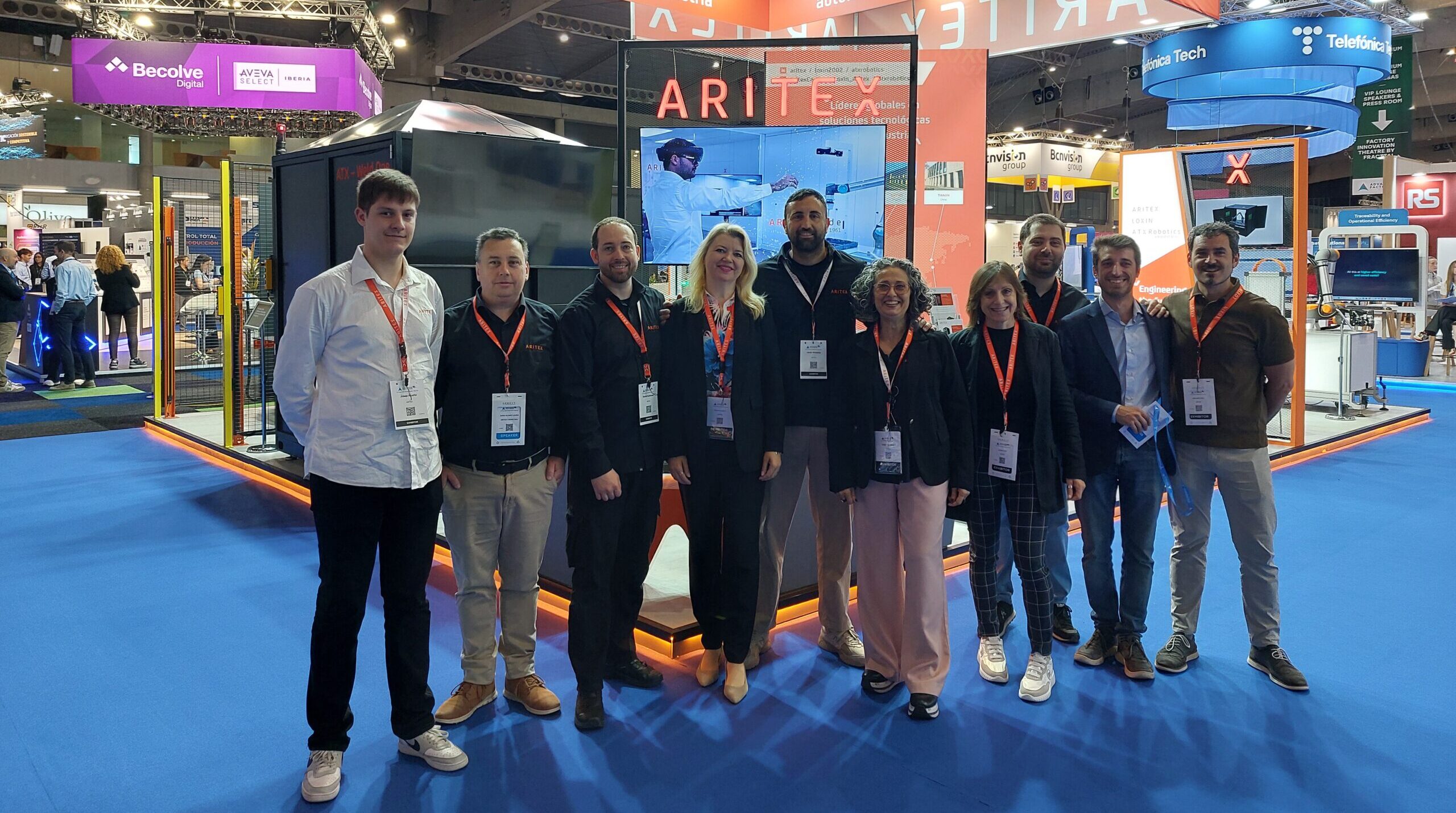
An overview of our participation at Advanced Factories 2026
Advanced Factories 2026 has once again proved to be one of the industry’s major meeting points, a space for sharing real-world experiences and discussing automation,…

Digitalization and automation in SMEs: how Aritex is democratising Industry 4.0 through ATX Robotics (part 1)
After more than six decades leading automation projects for large OEMs, in 2020 Aritex decided to transfer its expertise to the SME sector through a…